A blog to help electrical engineers and students to learn electrical engineering topics. Basic Electrical Engineering, Power Systems, Electrical Machines, tec.. Now special course on MATLAB for Beginners.

Class

Class
Showing posts with label electricity. Show all posts

Sunday, December 6, 2015

Advantages of Electrical Energy


transmission-of-electrical-energyIn the present age, electricity is essential for everyone and everything.  Whether industrial, commercial, agricultural or domestic, it is considered a most obedient and faithful servant of man.  This is because electrical energy has various advantages as compared to any other form of energy, whether mechanical thermal or chemical energy.  Some of the main advantages of electricity are:


  1. Economical :   Taking into consideration the factor of utilization, ie. due to less wastage, electrical energy is economical

  2. Cleanliness : Due to absence of fuel  electrical appliances provides cleanliness

  3. Pollution :  Due to absence of flue gases, soot, etc., there is no pollution of the atmosphere.

  4. Control : The electric supply and devices using electrical energy, can be controlled easily and effectively.

  5. Quickness : Electrical energy is ready for use and no time is needed for preparation

  6. Maintenance    : Appliances using electrical energy are robust, smaller in size and need little maintenance.

  7. Illumination  :  The light provided by a bulb or fluorescent tube is greater than the light obtained from a candle, kerosene lamp or petromax.

  8. Magnet : Electromagnets are more stronger and powerful than other magnets

  9. Heating of non-conducting materials :  Uniform heating of non-conducting materials such as bones, drying textiles, etc., is possible only with the help of electrical energy.

  10. Storage battery etc.: Electrical energy has made it possible to have electroplating, electrotyping and storing electricity in the form of chemical energy in storage batteries.

Wednesday, December 2, 2015

Effects of Electricity


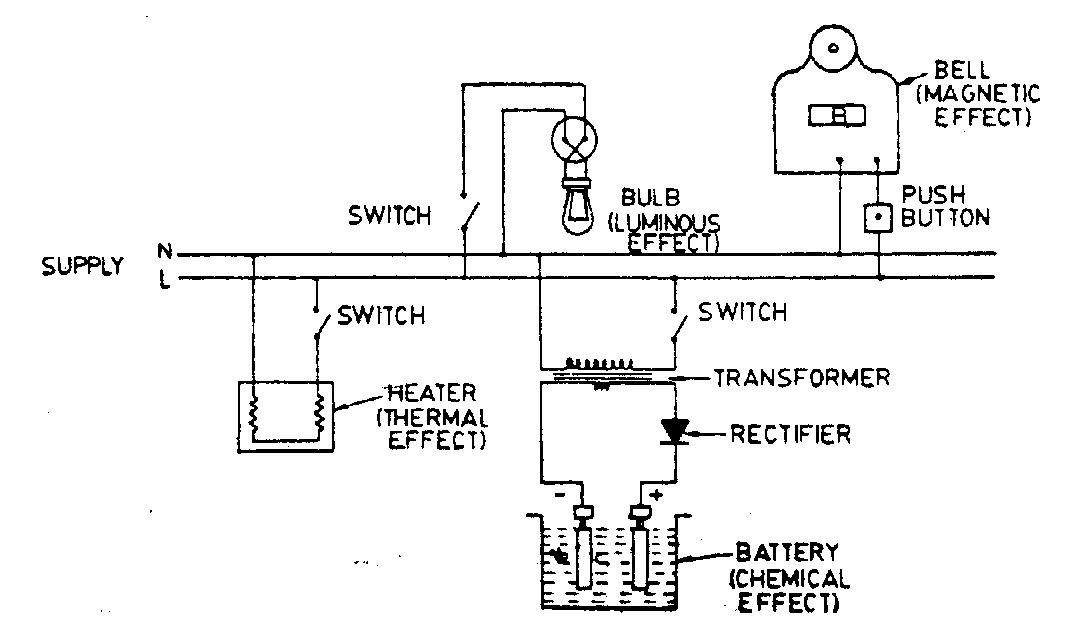
Thermal effect : -  The current flowing in a conductor always causes the conductor to become hot.  This is known as thermal effect as in an electric heater or electric iron.

Luminous effect :-  When the temperature of the conductor is increased sufficiently, then light is emitted.  This is known as the luminous effect as in an electric bulb (i.e. incandescent lamp).  Light can also be obtained by ionizing the mercury or sodium vapour as in as fluorescent tube and sodium vapor lamp respectively.

effectsofelectricity

Chemical effect:-    When current flows through a certain liquid chemical known as electrolyte, Chemical changes occur in the liquid and in metals immersed in it and connected to the circuit.  This is known as the chemical effect as in battery charging.

Magnetic effect:-     The current flowing in a conductor always produces a magnetic field around the conductor.  This is known as the magnetic effect as in an electric bell or electric motors.

Tuesday, December 1, 2015

Basic Concept of Electricity


INTRODUCTION

Electricity is the modern friend of man.  It has become a part and parcel of our daily life.  Where ever we may cast our eyes, we find the achievements and attainment of electricity.  It has really made the life of a person quite comfortable.

Talking on telephone with friends and relatives, watching football match on T.V. effective & efficient cooling of Air conditioners, cooking the food by cooking range, heating the food by microwave oven, quick ironing of clothes with electric iron etc have been possible only due to our modern friend electricity.

An electric bulb, an electric bell and a room heater, all require electric current for their operation but current produces different effects in each case. Therefore before numerating the various applications of electricity, it is essential that we should consider the various effects of electric current.

WHAT IS ELECTRICITY


The electrons in the outermost orbit are known as valence electrons.  In some elements these valence electrons are loosely bounded to their nucleus and can he dislodged by some means or the other.  Such electrons are also known as free electrons. Certain materials such as Copper, Aluminium have many free electrons.  These free electrons used to move haphazardly in all directions from atom to atom in the material. If, however the free electrons can be caused to move through the material in the same general direction, the net electrons movement is the flow of electricity and is called an electric current.