


Transformer is a static electrical device which
transforms voltage/current and transfers power with out change in frequency.
The basic principle of transformer is the electromagnetic induction.
Basic Principle:
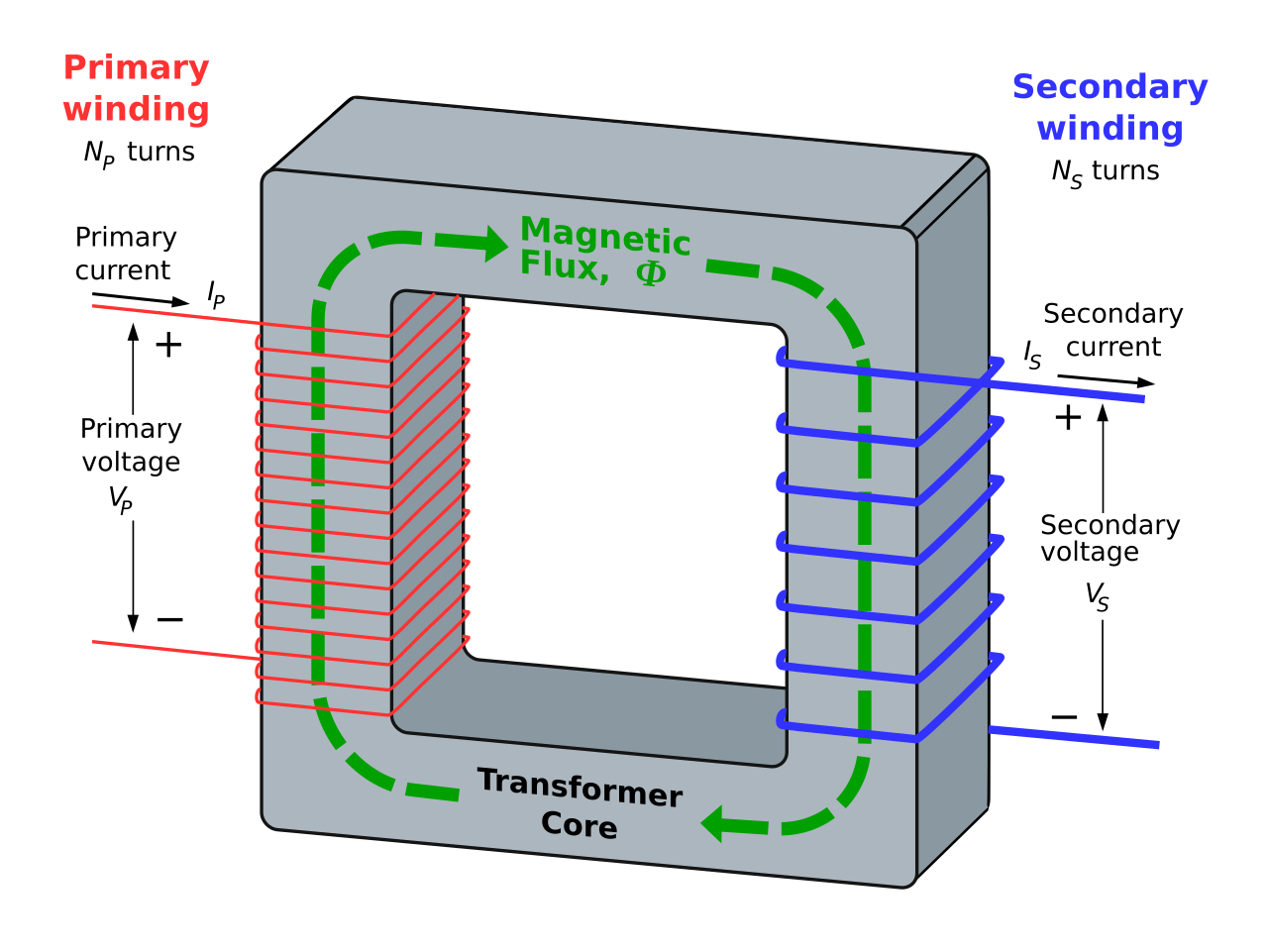
Basically a transformer is a pair of coils wound on a
ferromagnetic core as shown in figure. The reason for using ferromagnetic core
is that it results in high values of magnetic flux linkages. The vertical
portions of the core are referred to as limbs and the top and bottom
portions are the yokes. The winding which is connected to the supply is
called primary and the winding connected to the load is called
secondary.
When an alternating voltage is applied across the
primary winding, it results in a current and produces an alternating flux Q in
the core. This flux links with the secondary winding also and induces a voltage
in it.
 Since the flux linkages are the same for both the
windings, the e.m.f induced per turn will also be the same. If N1
and N2 are the number of turns in the primary and secondary
windings respectively, then emf induced in primary, V1 = N1
x emf per turn and emf induced in secondary, V2 = N2
x emf per turn. The ratio V2/V1 is called transformation
ratio and is usually denoted by K. Since the ampere turns in
the-primary and the secondary are the same,
Since the flux linkages are the same for both the
windings, the e.m.f induced per turn will also be the same. If N1
and N2 are the number of turns in the primary and secondary
windings respectively, then emf induced in primary, V1 = N1
x emf per turn and emf induced in secondary, V2 = N2
x emf per turn. The ratio V2/V1 is called transformation
ratio and is usually denoted by K. Since the ampere turns in
the-primary and the secondary are the same,
N1I1 = N2I2
If it is assumed that there is no loss in the
transformer, then
VlIl=V2I2
The above relations can be summarized as,
K = N1/N2 = Vl/V2 = I2/Il

Ideal transformer:
A transformer having no losses in it is called an ideal
transformer. An ideal transformer has no leakage reactance (all the flux
produced by the primary winding links with the secondary), no I2R loss
in the winding and no core losses. In practice, it is impossible to realize
such a transformer.
For ideal transformer
K = E1/E2 = Vl/V2 = I2/Il
A small percentage of flux produced by both the
windings does not link with the other winding. This flux is called leakage
flux. The primary leakage flux induces a voltage in the primary winding alone
and the effect of this is like having a reactance in series with the winding.
This reactance is called the primary leakage reactance. Similarly there is a
secondary leakage reactance due to the leakage flux in the secondary winding.


